

6 warning signs your healthspan won't match your lifespan—and what to do about it
+ Did you hear what Dr. Stacy Sims says about coffee for women?




I watched my mother suffer. Now I'm aging differently.
By Elspeth Raisbeck
When we read news stories about people reaching their 100th birthday, we mentally give them a round of applause. That’s a real milestone, but after the applause, do you ask yourself if you actually want to live that long? What if we’re sick and unable to live fully for the last 30 years? Will life be worth living?
Longevity runs in my family – my grandparents were in their 80s when they died, and my mum was in her 90s. I watched them all suffer with poor health, and after Mum died, I decided that wasn’t going to be me. I’m determined my healthspan won’t fall short of my lifespan.
As a nurse and clinical trainer for 35 years, I’ve seen it all. There are telltale signs that we might not live a long life and signs we might not live a long and healthy life, but the good news is we can influence them.
These are six of the most common signs that your healthspan won’t match your lifespan.
Sitting down to put on your shoes can be a sign that your balance isn’t as good as it could be. Basically, you’re automatically doing what your body needs to protect itself from toppling over. Poor balance leads to falls, which can happen when you least expect them, like slipping on ice in winter, wiping up a spill in the kitchen, or tripping over a toy — basically, anytime the mind is elsewhere and has left the body with the job of navigating a space.
Fix poor balance:
We lose muscle mass and strength (called sarcopenia) after age 40. When we lose muscle, we lose our ability to right ourselves when we wobble or slip. The leg, butt, and core muscles are our stabilizers, so we can work on these at the gym with a trainer, but start by simply doing squats in the kitchen while you’re waiting for the microwave to finish or the kettle to boil.
Stand with your feet hip distance apart, or a little wider. Put your arms out in front of you for a counterbalance, and slowly bend your knees, keep your back straight, and stick your butt out, as if you’re trying to close a cupboard door behind you. Go as deep as you can and stop if you have pain in your knees. Slowly come back to standing. Repeat up to five times and gradually increase your repetitions.
Push-ups from the kitchen counter also work well for the chest and abs. If you like a class but not the sweat, or have impairments, try Tai Chi, yoga, and balance ball lessons.
We also recommend using ChoreFit, the first chores tracker fitness app. Meet ChoreFit Founder Stella Tamul.
We need the sugar from carbohydrates as the body’s fuel, but in the right amounts. In diabetes, the body can’t regulate sugar levels, but we all need to be aware that eating too much of some carbohydrates can make blood sugars spike, which stresses the body.
Too much sugar for too long damages the blood vessels, especially the small ones in our eyes, kidneys, heart, and brain. This damages the organs the blood vessels supply, putting us more at risk of heart disease, heart attacks, and strokes.
Fix blood sugar spikes:
You can get a glucose blood test with your doctor, or use a continuous glucose monitor (CGM) for a couple of weeks and experiment with the food you eat and resulting sugar levels. Some people are more sensitive to carbohydrates than others.
Even if you’re following a healthy diet, be aware of hidden sugars in ketchups, sauces, and other foods we think of as savoury.
Eat fruit as whole fruit or in a homemade smoothie rather than juice. The fiber in whole fruit slows down the release of sugars into the blood.
Love bread? Who doesn’t? Choose sourdough or wholegrain bread rather than white bread. Both are digested more slowly.
Love pasta and rice? Cook, chill, and re-heat it, as this stops the sugar spikes. The glucose molecule is quite loosely structured, which is why is comes apart easily and raises blood sugar quickly. When it’s cooked, chilled and reheated, it is more tightly bonded and doesn’t come apart easily, thus getting into the bloodstream more slowly.
Shift your diet toward more lean protein, as it’s important in strengthening muscle.
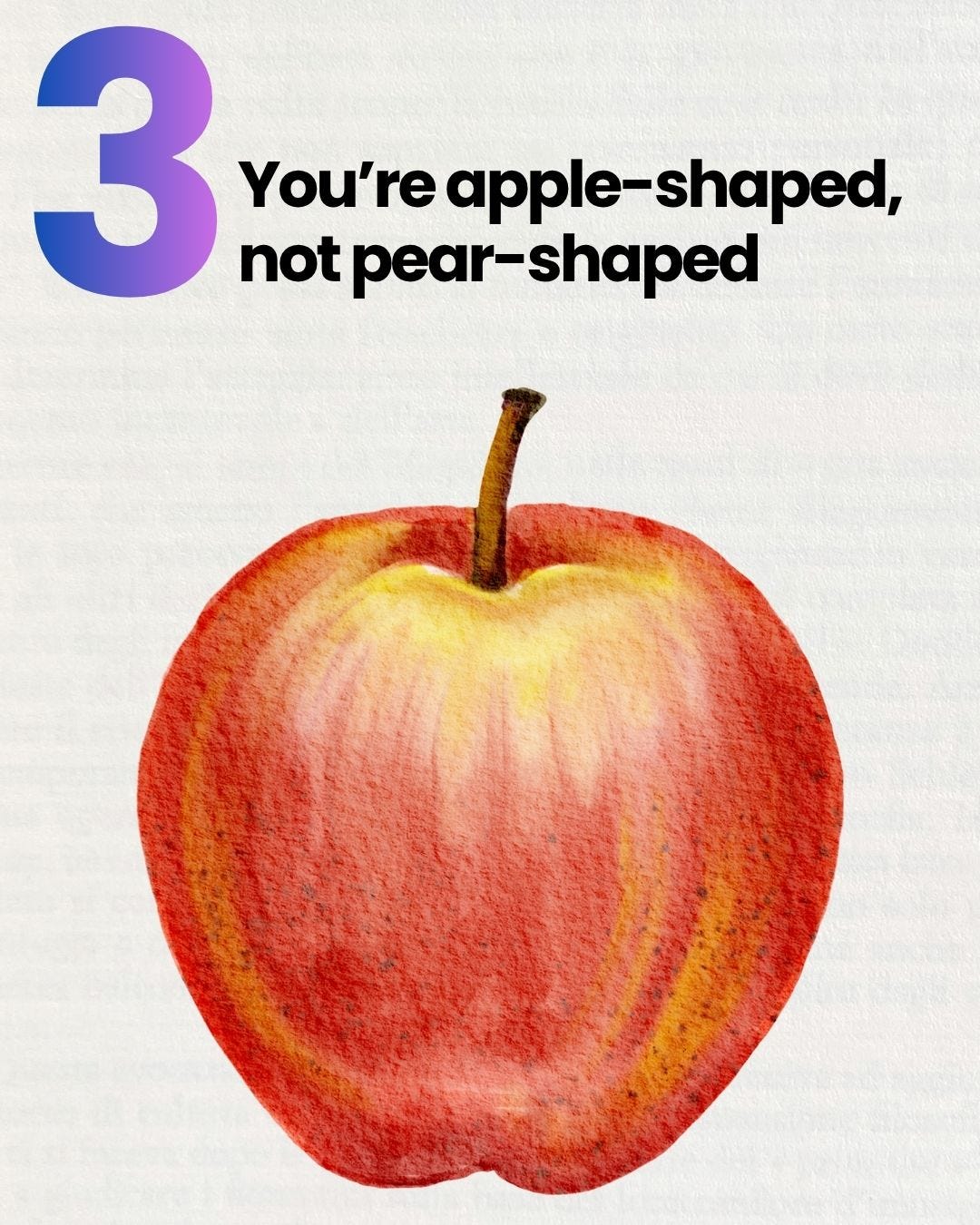
I’m referring to our hip-to-waist ratio: in other words, where we store our fat. Studies suggest that if we are apple-shaped — fat around the waist — we’re more likely to have it around our organs, known as visceral fat. And this can cause bodily inflammation linked to Type 2 diabetes, high cholesterol, and heart disease.
We need a little visceral fat to cushion our internal organs, but storing fat around our hips is a healthier indication of what’s happening inside.
Measure your hip-to-waist ratio:
Stand straight and exhale. Measure your waist with the measuring tape covering your belly button; then measure around your hips — the biggest part of the buttocks. Divide your waist reading by your hip reading to calculate your hip-to-waist ratio. The World Health Organization recommends a ratio of 0.90 or less for men and 0.85 or less for women.
Overall weight loss helps reduce belly fat, as does building muscle. Work on the big muscles of the thighs and butt, as these will burn more calories, but all-over toning and muscle rebuilding is important.
We also recommend exercising while wearing a weighted vest — The Carry is one of the best weighted vests for women.
Along with the muscle loss, we lose bone mass after age 40. A DXA scan looks at how dense (and therefore strong) our bones are. It can help diagnose osteoporosis or osteopenia. Osteoporosis is bone thinning, so instead of looking like a dense honeycomb, it’s full of holes. Osteopenia is the stage before osteoporosis.
Half of all women will get osteoporosis, which puts us at risk of spinal and hip fractures, but osteoporosis and osteopenia are reversible for most. My mother fell and broke her hip, and life was never the same. She went from living independently to needing 24-hour care, her quality of life deteriorating every day of the 18 months she lived after the fall.
Fix your risk of osteoporosis:
Ask your doctor for a DXA scan, especially if you’re over age 50 or have a family history of osteoporosis.
Eat a diet with plenty of protein, calcium, and Vitamin D to improve and prevent thinning bones.
Do muscle-building exercises and jump rope, which puts a shock wave through the bone.
We recommend Kaari: evidence-based exercise programs to prevent osteoporosis and osteopenia, in a convenient digital format. Programming is created by a doctor of physical therapy and an osteoporosis-specialized, NASM-certified strength trainer, and led by BoneFit-trained coaches.
Take specialist advice, as women with osteopenia/osteoporosis or other conditions need an individual, graded approach.
More about preventing osteoporosis on The Midst: Seen Nutrition founders create 1st calcium chew made from real food
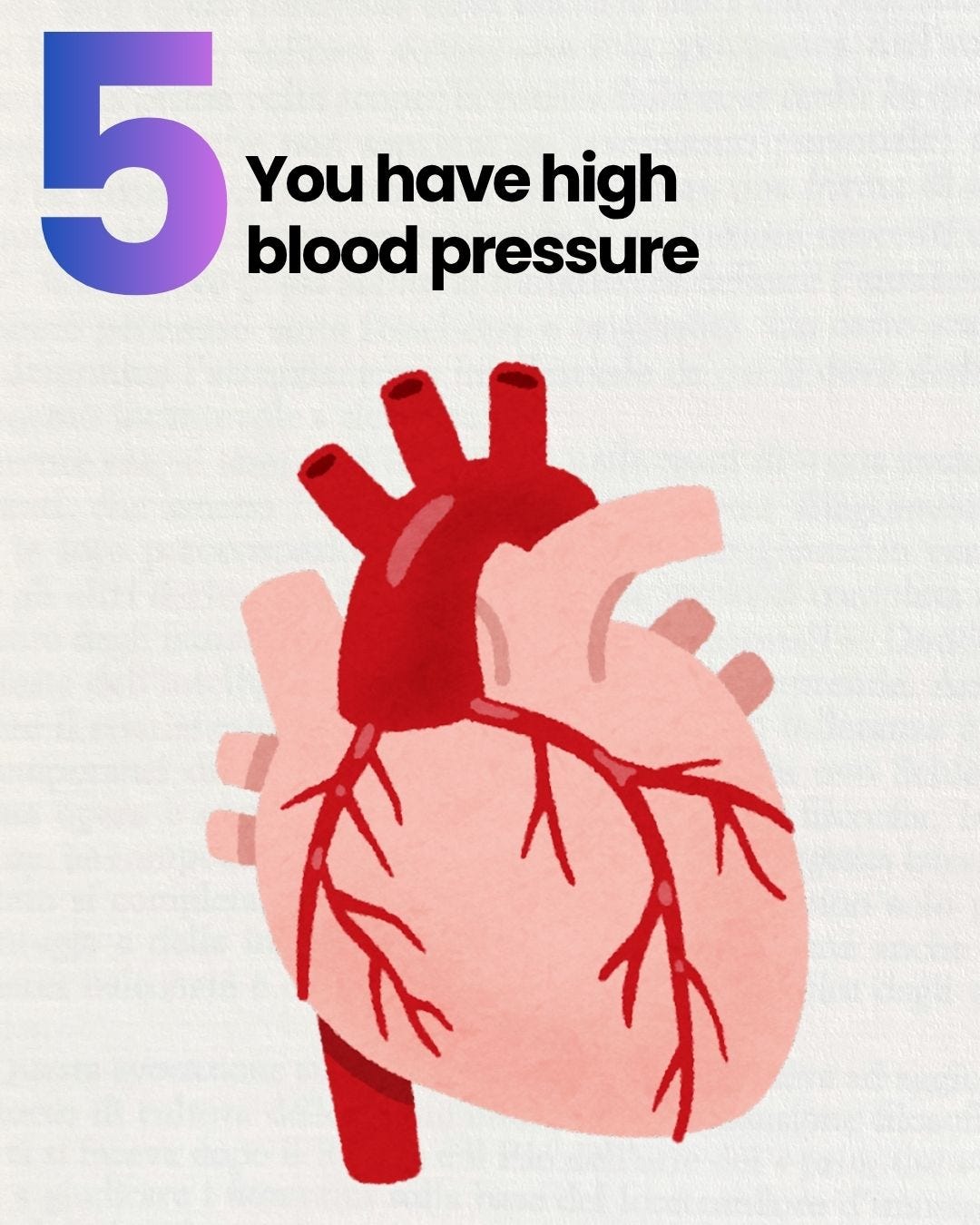
High blood pressure (BP) has virtually no symptoms; you may not realize you have it. Blood pressure reflects heart health and pressure in the blood vessels. If it’s too low, we feel faint and feeble, but too high, and small vessels can rupture, meaning a stroke or a heart attack.
Fix high blood pressure:
Ask your doctor or nurse to test your blood pressure, or buy a home monitor and check it regularly yourself. The ideal is around 120/80. The first reading (120) is the force of the heart pushing blood out, and the second reading is how well it relaxes after.
Discuss it with your doctor if it’s too high (or low and you have symptoms such as dizziness, lightheadedness, fainting, blurred vision, and fatigue).
Muscle strength, agility, and freedom of movement are key to healthy aging. You might be fine now, but down the line you might be prone to falls and the inability to get up without help from a friend or a piece of furniture.
Your future self will thank your current self for putting in the practice to get you up easily.
Take a staged approach. This video explains the process and encompasses all the actions we talked about above that will improve your strength and mobility.
Final thoughts
My old lady body is a work in progress, and my motivations are many — I want my clothes to fit, I don’t want to end up like my mother and grandmother, I want to age with strength and independence, on my terms.
Treat exercise like cleaning your teeth or making the bed — just do it. I do squats and push-ups while I wait for the kettle or the microwave, and I made a small gym at home. The best time to start was 20 years ago. The second-best time is now: do it and your future self will thank you.
This story was first published here on the-midst.com.

Why your coffee habit might need a rethink
When I saw Dr. Stacy Sims’ latest story headline — “Coffee, Decoded: What the Research Actually Says About Caffeine and Women” — my first thought was, Pleaseeeeeeee, pleaaaaaaaaase don’t take away my coffee. It’s like my only vice, and I drink half-caff to boot.
But I do admit that my afternoon coffee feels a little much lately and apparently that’s common during perimenopause.
Sims says most caffeine research was done on men, and caffeine simply doesn’t move through a female body the same way. Here’s the science in plain terms: men and women carry the same genes for processing caffeine (CYP1A2, the liver enzyme that clears it, and ADORA2A, which shapes how your brain reacts to it). The difference is hormonal.
Estradiol slows CYP1A2 down two ways — it tells the gene to produce less of the enzyme, and it competes with caffeine for the same clearance pathway. So during high-estradiol periods (the luteal phase, oral contraceptives, MHT, pregnancy), caffeine lingers longer. Testosterone does the opposite — it speeds clearance up.
OMG, one study found women were roughly twice as likely as men to report jitters or a racing heart from the same dose, and about half as likely to feel the energizing lift.
The perimenopause plot twist: as estradiol drops, caffeine actually clears faster — which means it hits harder and sharper instead of building gradually. That’s likely why your reliable 3 pm cup can suddenly feel like three double shots. Post-menopause, clearance slows again, and caffeine has been linked to more intense hot flashes and night sweats (the old caffeine-weakens-bones theory, though, doesn’t hold up when calcium intake is adequate).

3 things to do with this annoying information:
Don’t mirror a male training partner’s caffeine dose or timing before a workout or race — your clearance rate isn’t his.
Keep a caffeine curfew of at least 6 hours before bed, earlier if you’re peri- or post-menopausal.
If coffee feels different than it did in your 30s, believe your body and adjust the dose or timing rather than pushing through.
The bigger point isn’t to quit coffee — Sims isn’t about to either. It’s that “just drink less caffeine” advice was never built with your physiology in mind, so it’s worth tuning the habit to your own hormones instead of a generic rule. — Amy Schroeder

The Midst L.A. is only 2 months away!
More speakers to be announced. And, no, you don’t have to be a founder to attend. :) Women from around the U.S. are planning to meet up! Get your ticket before they sell out.
P.S. Thank you for following us on Substack.
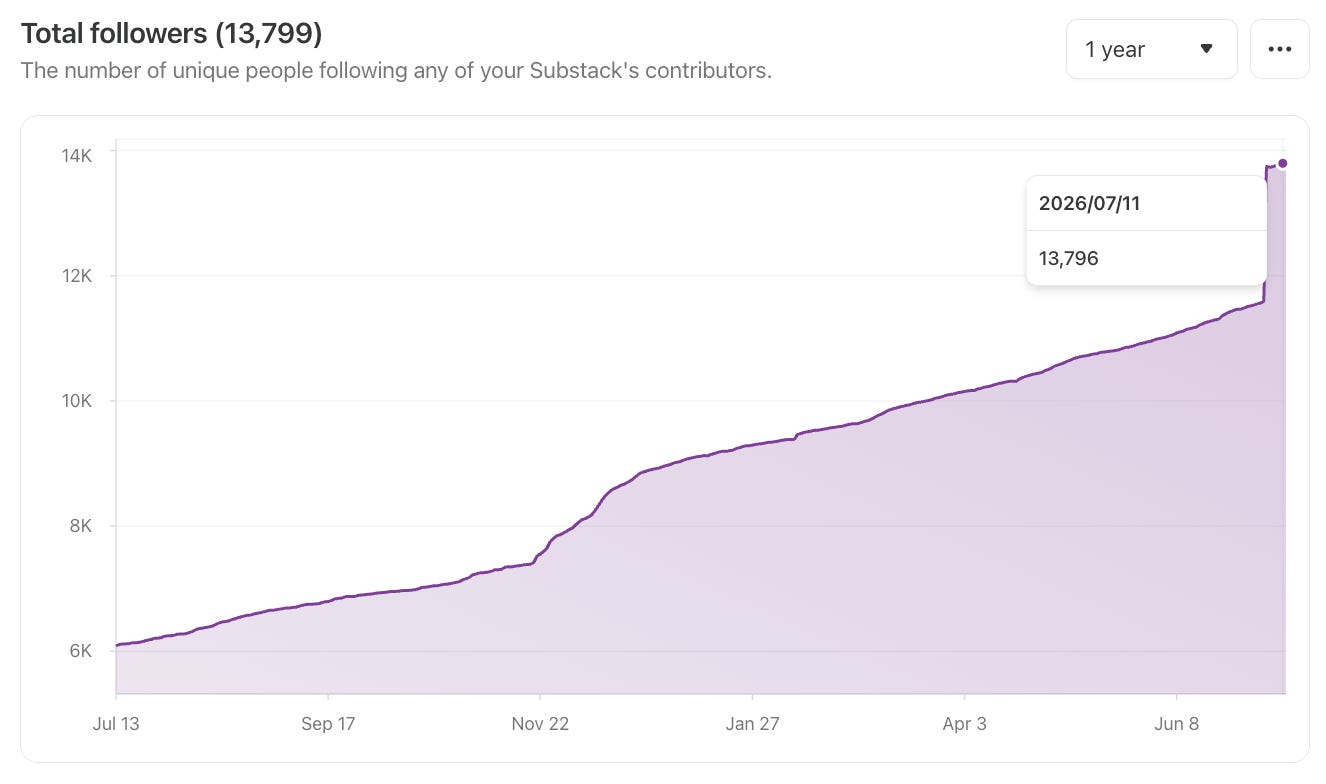
We love following you, too! We hope to see you here on Substack Notes (it’s kinda like Twitter) soon. We’re talking about whether we’re brave enough to try a cold plunge, Starbucks’ delicious 1990s soundtrack, and really long neck hairs.
Good points for people to assess!
This is a profoundly important piece. Elspeth’s line about your future self thanking your current self hits so close to home. We spend so much time worrying about the number of years we have, but protecting our independence—both physically and structurally—is what actually gives those years dignity. That cooked, chilled, and reheated pasta trick for blood sugar is an absolute revelation too! Thank you for sharing this, Amy.