

Stop being everything but yourself
How to overcome self-abandonment, by psychologists Badass Rebellion


How to overcome self-abandonment
By Lucy Smith, PhD • Jamie Wilson, PhD • Avery Hoenig, PhD of Badass Rebellion
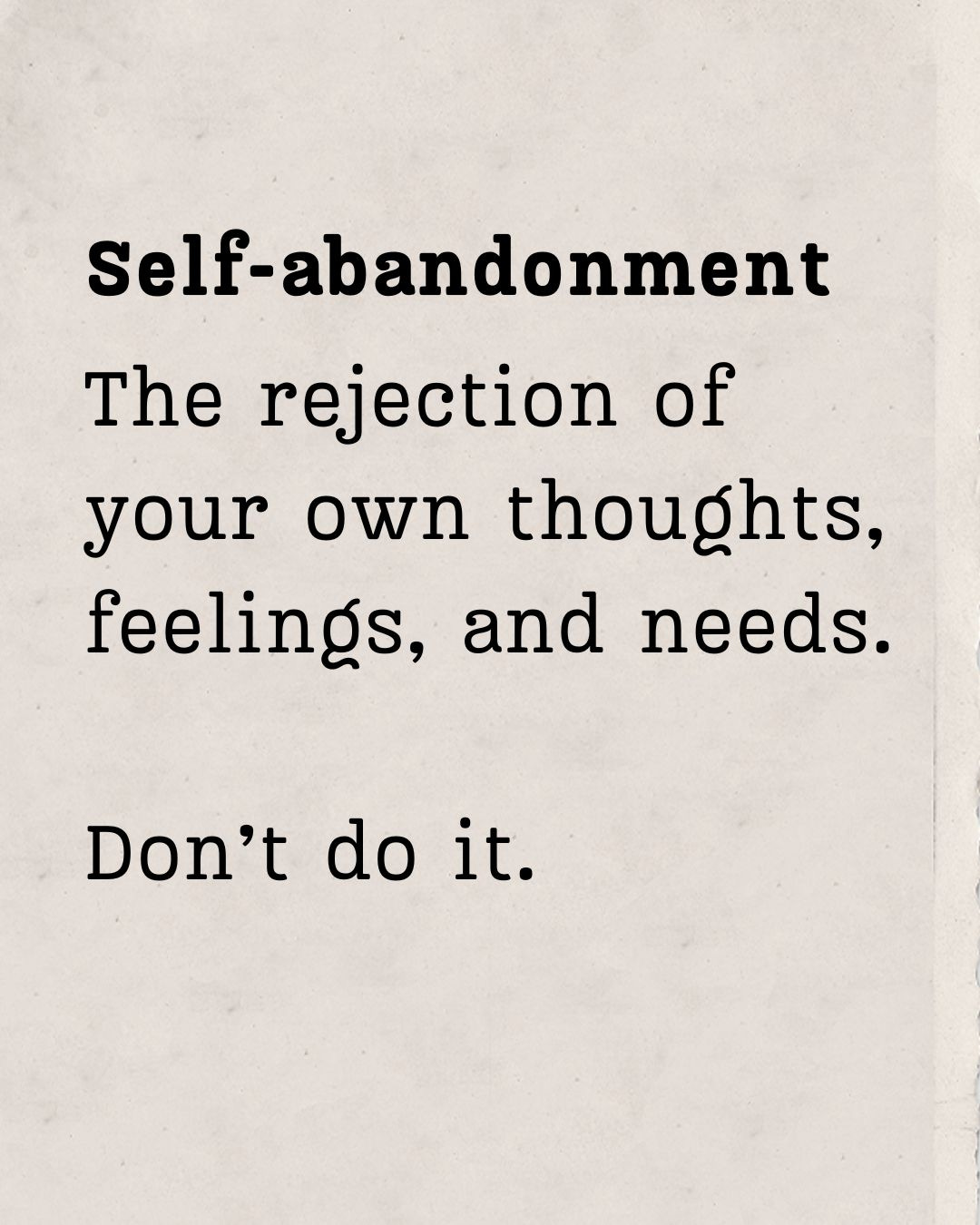
You’ve been everything to everyone.
You hustle, overdeliver, say yes when you mean no, and carry the emotional weight of everyone around you. You’ve spent your whole life perfecting your expected roles—daughter, wife, friend, employee, mother—all while silencing your own desires and losing yourself in what other people want. You tell yourself you’re fine. You’re strong. You’ll rest later. But the truth is, you’re exhausted.
You’re done—and you’re not alone.
Filled with compassion, powerful stories, and concrete change strategies, Overcoming Self-Abandonment will help you recognize the patterns that are draining you and give you tools to reclaim your time, energy, and identity. This is not about becoming someone else. It’s about finally becoming you. Enjoy this exclusive excerpt of chapter 1.

Understanding self-abandonment
It’s likely that the term self-abandonment is new to you. It also might be a bit confusing. You’re not alone if you find yourself thinking, Self-abandonment? How could I possibly abandon MYSELF? Isn’t that . . . impossible?!
We understand. However, we’re guessing that while this term may be new to you, the feeling may be familiar.
The feelings of resentment, anger, or exhaustion you get when you tend to everyone’s wants and needs except for your own? That’s a sign of self-abandonment.
The feelings of stress, worry, fear, or uncertainty that arise when you don’t trust your own knowledge and wisdom and look to others for guidance, opinions, and expertise? In essence, when you don’t trust yourself? That’s a sign of self-abandonment.
The feelings of loneliness, disconnection, or numbness you experience when you’re feeling detached from your surroundings or others? That’s a sign of self-abandonment.
The feelings of distress, frustration, or shame that bubble up when you get caught in a cycle of self-criticism and self-loathing? That’s a sign of self-abandonment.
The overwhelming pressure you feel to fit into perfectionistic norms? That’s a sign of self-abandonment.
Take a second to name any of these feelings that resonate with your experience.
These emotions serve as clues that you might be abandoning yourself. But self-abandonment is about far more than how you’re feeling in the present moment. See if you relate to Isabel.
Isabel is in her late thirties and has been married for eleven years. She has three children in elementary school. She’s always been a high achiever: a straight-A student throughout school, a model employee in her graphic design career before having children, and more recently, a classroom mom extraordinaire who is queen of the Pinterest-worthy party. She ensures her family and home run smoothly and efficiently. Her husband, George, can be helpful in caring for the kids and doing chores around the house when asked directly and specifically, but Isabel is the default parent. She carries all the cognitive load in terms of keeping track of what needs to be done and in executing the majority of childcare and household tasks.
In therapy, Isabel reports feeling frantic, exhausted, and overwhelmed, noting she feels a lot of pressure to do it all and to do it all perfectly. Everything feels like Isabel’s responsibility, from ensuring everyone is well-dressed and fed with “healthy” foods to guaranteeing everyone has arrived at all their activities on time and well-prepared to keeping the house clean, organized, and well-decorated. Isabel has a hard time asking for help, both from her husband and from others. She believes she should be able to manage it all on her own, especially since she’s not employed outside the home. In addition, she’s mindful of the family’s tight budget and tends to prioritize spending money on her kids and the essentials. She’s reluctant to hire outside help, including babysitters for date nights. Overall, she feels like she can only get help if she really needs it, which means she rarely gets assistance or support.
Isabel has a nagging itch that there could be more to her life. She’d always imagined she’d be happy with a solid marriage, three kids, and a lovely home, but instead she feels empty, stifled, and uninspired, like she’s slogging through the grind every single day. She’s incredibly grateful for all that she has, yet she feels like she’s missing something. She often describes feeling as if she’s “dead ass last”—so focused on getting things done and taking care of everyone else that she has no time or energy left for herself.
Isabel has lost touch with herself. Because she spends her days doing and caring for others, she has very little time to slow down and truly connect with herself. She’s so focused on being in “mom” or “wife” mode that “Isabel” mode is a forgotten setting. There’s no time for her hobbies or leisure activities, like reading a good book, drawing for fun, journaling about her feelings, or simply sitting on the porch to watch the sunset, all things she’d enjoyed regularly when she was younger. To top it off, Isabel is really hard on herself about all of this. What’s wrong with me? Why am I so burned out, depleted, and irritable? She feels angry with herself, both for not being content with what she has and also for not doing more to fix whatever the problem is.
The first thing to understand about self-abandonment is that it doesn’t happen overnight. Isabel is a good example of that. She has abandoned herself slowly, over time, by ignoring her own wants and needs, sacrificing herself over and over for the sake of others.
Self-abandonment happens consciously and unconsciously. For example, how often do you automatically respond with “I’m fine” when asked how you are? Sure, sometimes you are fine. But sometimes you are not fine. Perhaps you’ve intentionally made the decision to not share how you’re really feeling. Alternatively, you might be running on autopilot: so disconnected from yourself that you don’t know how you’re actually doing.
Like many other phenomena, self-abandonment happens on a continuum. Always responding with “I’m fine” when asked how you are might seem like a small thing, but it’s important. When we get in the habit of abandoning ourselves in small ways, we’re more likely to abandon ourselves in large ways.
The characteristics of self-abandonment
In our decades of work in private practice, in our workshops and speaking engagements, in our own lives, and with our friends and family, we’ve been taking notes and we’ve identified four overarching characteristics of self-abandonment. See if any of them feel familiar to you.
1. Believing That We Are “Not Enough”
Not-enoughness underlies all forms of self-abandonment. This belief that we are somehow not enough—that we don’t measure up, that we are less than, that we are worthless—stems from a scarcity mindset. We believe that not only are we not enough, but that there is not enough love, success, joy, connection, attention, and so forth available in the world. Sometimes, we are aware of our not-enoughness, and other times, it is a powerful, subconscious force outside our awareness. Not-enoughness often goes hand in hand with self-judgment, and it promotes a hustle-and-grind mentality: If I do more and achieve more, maybe I can finally feel like I’m enough. Maybe that next accomplishment will finally make me feel worthwhile. Many systems in our culture (namely, patriarchy and capitalism) leverage not-enoughness to keep us in line and to keep us small.
2. Defaulting to an External Guidance System (EGS)
When you’re trying to figure out how you’re feeling about something, do you ever find yourself polling those around you? When trying to make decisions, do you find yourself asking friends, family, or trusted mentors for their thoughts and opinions: Should I take the new job? Is Larry the right guy for me? Is it safe for my daughter to be dropped off at the mall with friends? Should I cut my hair short or leave it long? Do you ever consult Google to answer personal questions about your own life: Should I get a divorce? What makes a good mom? Is this heartburn or hunger? As women, we’ve been conditioned to look outside ourselves for direction and approval. In other words, we’ve been taught to lean heavily on what we like to call an external guidance system (EGS), where outside feedback trumps our own wisdom, leading us to minimize our own thoughts, beliefs, preferences, wants, or needs. We’re taught to make the “right” decisions that will please others. We value others’ opinions more than our own.
Similarly, we tap into our EGS when we follow external scripts or expectations: I guess I’ll be a lawyer like everyone else in my family. I really should be married by age thirty. All my friends stop working when they have children, so should I quit my job when I have kids? Blindly defaulting to scripts or expectations causes our decisions to become divorced from our own internal guidance, which increases the likelihood that we’ll make decisions that truly aren’t as good of a fit for us.
When we automatically default to our EGS, we send ourselves the message that other people’s opinions and beliefs matter more than our own, which leads us to depend on external direction and validation. We ignore our own knowing and intuition, as well as the opportunity to validate ourselves. Other people’s opinions, expectations, and rules exist outside ourselves, but knowing, intuition, and self-validation are found inside. When we forget to balance feedback from others with our own knowing, we’re at greater risk of self-abandonment.
3. Ignoring Our Internal Guidance System (IGS)
Just as each of us has our own EGS, we all have an internal guidance system (IGS) as well. We can think of this as our inner wisdom. Our knowing. Our intuition. As the name implies, the main function of the IGS is to guide, direct, protect, and empower us. It is there so we can be the experts on our own lives.
Unfortunately, many of us don’t feel like we are experts on ourselves. We trust outside influences instead of trusting our own internal wisdom. We doubt our intuition, believing it’s not enough. We spend our days consulting Siri and Alexa, but we’ve forgotten how to consult ourselves.
While our EGS is loud, our IGS more often speaks in whispers. There’s no shortage of outside opinions and feedback about who we should be and how we should live our lives. We’re inundated with messages that we can’t trust ourselves and our bodies, and we come to believe that, if left to our own devices, we’d languish indefinitely on our couches with an endless supply of potato chips and ice cream. In many ways, society discourages us from trusting ourselves, which leads to continued self-abandonment.
Does this mean that you should throw all external feedback out the window and never ask for advice? Of course not. But many of us have become so disconnected from ourselves that we don’t give any credit to our own intuition and wisdom. The work of reconnecting requires us to look inward first, and in the coming pages, you’ll discover how to do just that.
4. Hiding From Discomfort
We understand—no one wants to be uncomfortable! We are hardwired to want discomfort to go away, and we spend a lot of time and energy trying not to feel uncomfortable. It’s human nature to want to fix things, avoid awkward moments, and run away from anything that will feel hard for us and others.
But we can’t. Discomfort is an unavoidable part of being human. Authentically connecting with yourself and others will sometimes be uncomfortable. The good news is that as soon as you give up the notion that you can hide from discomfort, it frees you up to work directly with it.
Intrigued and ready for more? Buy Overcoming Self-Abandonment now.
This book excerpt was originally published here on the-midst.com.

About the authors
The authors of Overcoming Self-Abandonment, Lucy Smith, PhD, Jamie Wilson, PhD, and Avery Hoenig, PhD, are licensed psychologists who have each been in private practice for over a decade. They host a podcast, Inspiration from the Couch, and also started the Badass Rebellion platform for women who are tired of putting themselves dead-ass last in their lives.

Galentine’s Day is February 13!
Give your Grown Ass Lady pals a gift made by women, for women.