

The down-low on hair down there
+ "Because my dad died suddenly a decade earlier, feelings of resentment were buried under layers of sadness and grief."




Don’t beat around the bush
“The main purpose of pubic hair is to facilitate the ability to have a successful sexual experience, starting with keeping the genitals warm,” says Dr. Lauren Streicher, one of my favorite perimenopause doctors. “The obvious evolutionary advantage here is that people with warm genitals are more likely to take their clothes off. Historically, men were more likely to maintain an erection, even if the cave (or igloo) was very cold.”
This makes sense. But what about nowadays in a world with central heat — do we need pubic hair? I learned a lot from reading Dr. Streicher’s history of pubic hair on her Substack.

A few things I learned about pubes:
1. Pubic hair still has a practical job: More cushion for the pushin.
The hair and its natural oils reduce friction during sex, which is why going completely bare can lead to irritation or “rug burn.”
2. We’ll prolly lose pubic hair as we age
Thickness, texture, and coverage differ from person to person, and hair naturally thins with age as hormones decline — some women in their 70s and 80s have little to none left. Gradual, hormone-driven change is normal; a sudden loss or sudden excess growth is worth mentioning to a doctor, since it can signal an underlying health issue.
3. Removal is a style choice, not a hygiene requirement — and it’s nothing new.
Humans have been removing pubic hair since at least the 7th century, from Egyptian sugaring to Roman tweezing to 1970s Playboy slowly revealing more “bush” on its pages. The completely bare look took off in the 1980s and ’90s alongside the mainstreaming of porn. Today, most women who groom are simply trimming or shaving, not going full Brazilian — and the trend skews younger: women in their 20s and 30s are far more likely to remove it all than women 50+, often viewing it as no different from shaving their legs.
4. There’s no medical benefit to removing your pubes
If anything, grooming carries small but real risks — large studies (one reviewing over 73,000 women) found pubic hair removal is associated with a higher risk of gonorrhea and chlamydia, plus the more mundane risks of nicks, burns, ingrown hairs, and razor bumps. Feeling sexier and more confident after grooming is real, but it’s psychological and cultural, not biological.
If you do choose to remove your hair down there: clipping carries the lowest risk; an electric razor beats a manual one; do it sober, in good light; and if you’re going to a salon, make sure your aesthetician isn’t on their first day.
— Amy Schroeder

Feeling badgered by past family trauma
A few years ago, my family and I moved to the suburbs of Madison, Wisconsin, a city that holds special significance to me. It’s the place where my parents met, where my dad went to college, and where I had visited many times with him.
Initially, I loved exploring all the new places to go and things to do. But then I kept seeing these damn UW Bucky Badgers all over the place — sorry fans. The cheeky red and white mascot really started to bother me with its puffed-out chest, fisted hands, angry face, and sharply clawed feet. To me, the emblem didn’t just represent the college. It was also a strong reminder of my dad. Not the pleasant-to-be-around “fun guy” side, but the other one — the win-at-all-cost, always right, “you’re either with me, or against me” side.
And because my dad died suddenly a decade earlier, these feelings of resentment were buried under layers of sadness and grief. Feelings that went as far back as I can remember, during intense periods of conflict between my parents that led to a divorce where choosing sides was the only option. I chose my mother’s side, which, emotionally, was my only option. But this choice came with a cost — the loss of loving my father, and feeling loved by him. And all of these conflicted feelings felt frozen in a state of saturation, with nowhere to go.
Sixty-some days after my dad retired at the age of 60, I got the call that he was gone. Just like that. No warnings. Just gone. It was the first day of December, the first snow of the season and just after the first Black Friday that my dad didn’t work during his nearly four decade career in retail management at JCPenney’s.
Initial shock was followed by a strange and guilty feeling of relief: The loyalty tug-of-war between my divorced parents that persisted for many decades was finally over. I wouldn’t have to hear him utter the phrase “your Mother” as if it were a swear word. I would no longer hear his booming voice on my answering machine commanding me to pick up the “[insert expletive] phone.” I wouldn’t have to stress over making plans with him because I could never be sure of the mood he’d be in that day or where my tolerance level would be.
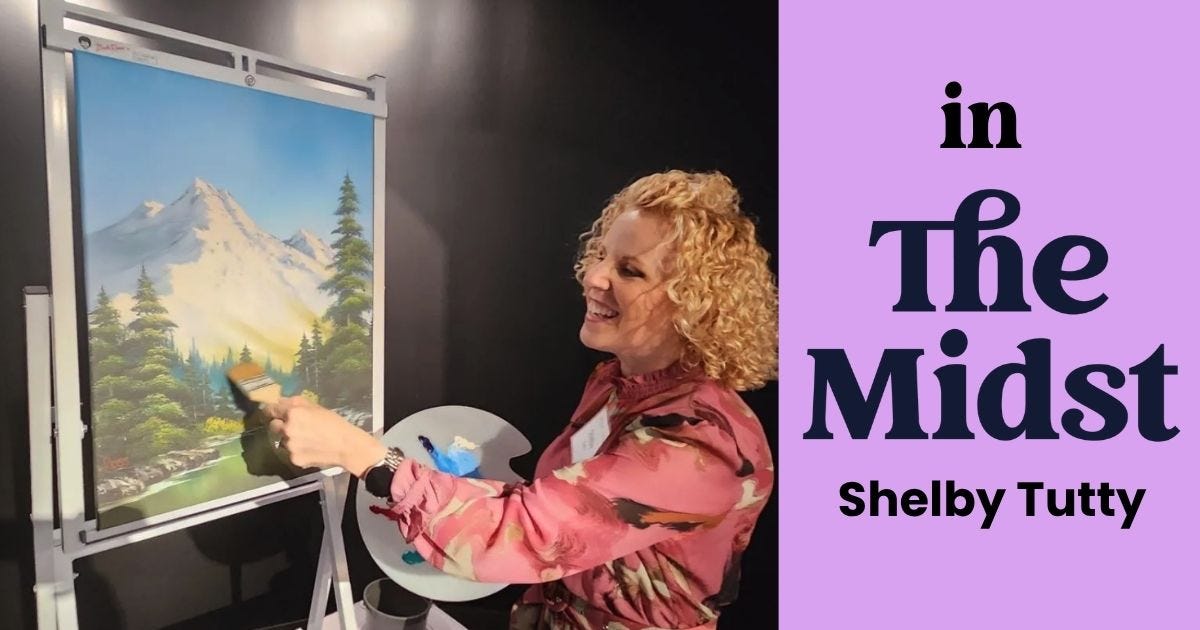
Perimenopause coach Shelby Tutty is in the midst of rediscovering the curiosity she had as a kid
“At 22 years old, I could not envision ever being a wife and mother, but that’s what I am today.”
Age: 56 • Location: Chicago, IL
I’m in the midst of:
Making myself laugh by rediscovering the spirit and curiosity I had as a child.
What would 22-year-old you find most baffling about your current life — in the best way?
In my 8th grade social studies class, we participated in a multi-week activity that encapsulated my excitement for my future. We randomly picked profiles of adults, complete with fictional careers, salaries, relationships, and children. Using this information, we had to construct a life within this framework, sort of like combining The Game of Life with The Sims.
I picked Profile #9, which, in my opinion, was the jackpot of all profiles. My sim was as an independent, single, career woman in a high-powered job earning $120,000 a year (this was in the early 1980s). The life I built was one of work and jet-setting travel while living in my exquisitely decorated penthouse apartment.
Even before this classroom project, this was the vision I held for myself. I was going to dedicate my life to a big career.
Then, I met my future husband in graduate school. We started dating a year after we graduated, and the night he proposed to me when I was 28, I felt my life change tracks from the destiny I had planned for myself to something else. That night, I journaled about my decision to say “yes” and to process what this meant for me. Was I giving up on my dream or making a better one? I didn’t know at the time.
At 22 years old, I could not envision ever being a wife and mother, but that’s what I am today. My husband and I have been happily married for 26 years, and our twins are about to turn 21. Although my husband always supported my career goals, it was me who changed. Once the twins came along, my career ambition mellowed. I no longer had the drive to focus solely on my career, and they helped shift my whole perspective on what truly mattered to me.
I’ve had a long work life and started my own business coaching and educating women going through perimenopause, but there are things I’ve missed out on because I wanted to be available to the twins, especially when they were young. I never went to law school, I never earned my PhD, and I never rose so high in my career that I could see the sky above me. When I look at everything other women have achieved and their career accolades, I’d be lying if I said I wasn’t somewhat jealous. But then I think about all the things I’ve been able to do and achieve within the life I’ve made for myself and my family.
Starting my own company was driven more by a desire to serve rather than ambition. I believed I had a unique skill set that could benefit women approaching menopause, and it would be selfish to do nothing when I knew I could help.
Life doesn’t always unfold as you expect, but I’m happier than I ever imagined with a life I once believed wasn’t meant for me.

What’s a belief you held tightly for years that you’ve quietly let go of?
I feel like going through perimenopause has unlocked parts of my brain that were previously unavailable to me. Had you asked me this question ten years ago, I don’t think I would have been able to answer it. In order to let go of a self-belief, you have to recognize that you have one. They become the foundation of our operating system, and we don’t always notice them running in the background.
Now, I’m much more reflective about the attitudes, behaviors, and beliefs I hold about myself, and I’ve discovered some interesting things about me in the process. I gently question everything that I’ve held guarded and have been working to adapt as needed. This is a part of the growth that comes along with perimenopause if you let it.
One of the beliefs I’ve held since childhood is that I need to be perfect to impress and succeed. Perfectionism takes time and a lot of mental energy, which frankly, I don’t have any longer in midlife. The desire for flawlessness held me back from opportunities that could have been amazing, due to fear of failure, and ultimately burned me out.
Going through perimenopause exposed my biggest weaknesses, and I had to learn to work within the constraints it placed on me. I could no longer show up in the world the controlled way that I wanted to, and I was forced to let go of some of the limiting beliefs I had of myself, including perfectionism.
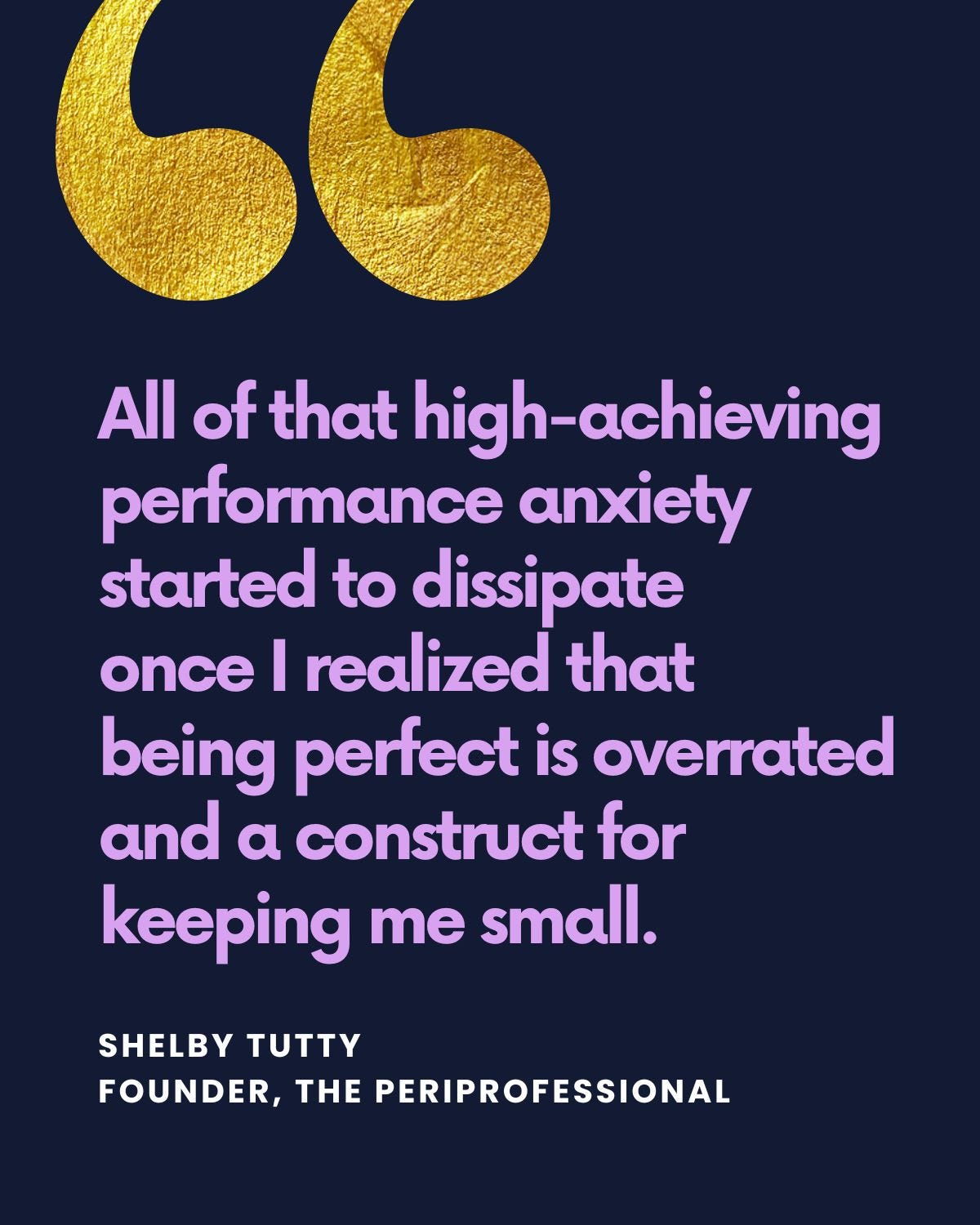
All of that high-achieving performance anxiety started to dissipate once I realized that being perfect was overrated and a construct for keeping me small. This tendency hasn’t disappeared quietly, but it’s something I’ve been working on for a while and have made real progress.
What’s a “no” you’re proud of?
I’ve been trying to say “yes” a whole lot more lately, but there’s one “no” that I’m proud of. Marketing of menopause products has become a big business, and while there may be a place for it elsewhere, I’ve kept The Periprofessional, my educational platform and weekly newsletter on Substack, free of affiliate links, outside advertising, or sponsored products. Being self-supported was a promise I’ve kept since day one.
Subscribe to Shelby’s Substacks:
The Periprofessional (for perimenopause information that won’t bore you to tears)
You’ve just read the second edition of our IN THE MIDST series, featuring talented women who subscribe to The Midst Substack.
 | A guest post by
|
 | A guest post by
|
I'm in for talking about pubic hair publicly! I like the evolutionary aspect of why we have them and the expectation that they may disappear as I age.
I’m thrilled to have been featured in the article! My hope is to help raise awareness and normalize some important topics for women, including letting go of limiting beliefs, being open to new possibilities, and celebrating success for ourselves rather than some external standard.
Great photo of the Amazing Trio - you, Rachel, and Dr. Streicher!
Great article, and wise choice to feature Shelby Tutty!
The premise of the beginning of the article appears to be that sex = penetration. I highly suspect that the divide is based on sexual preferences. I would be willing to bet that most who prefer penetration don't care if their partner removes their pubes, while most who prefer oral like smooth genitalia.